
What Gets Approved on Paper Isn't Always What Happens: Inside the World of Shariah Audit
A bank launches a new financing product. A committee of respected scholars reviews the structure,
checks it against the Shariah, and signs off. The certificate goes on the wall. The marketing calls it
halal. As far as most customers are concerned, the matter is settled.
Dr Luqman Seriki’s work begins exactly where that certainty ends.
“A product may have received Shariah approval on paper,” he says, “but Shariah audit asks: was it
actually executed that way?” It is a simple question, and it opens onto one of the most consequential — and least understood — corners of Islamic finance. Because compliance, as he puts
it, “is not established by the name of a product; it is established by the substance and execution of the transaction.” A perfectly structured contract can still be undone by a weak internal control, a
misconfigured system, or an income posted to the wrong ledger.
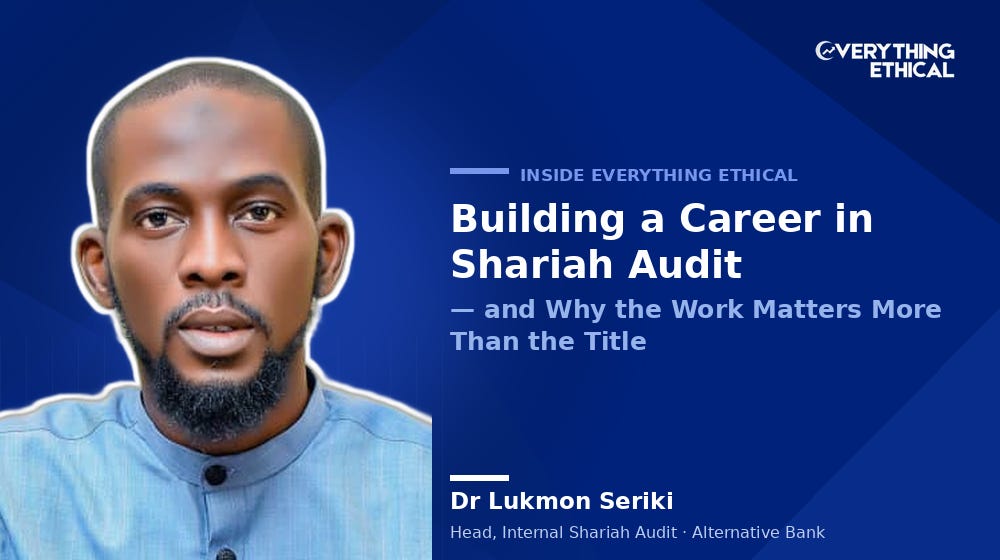
Head of Shariah Audit at the Alternative Bank, with qualifications from AAOIFI and INCEIF and a PhD examining Shariah audit practice in Nigerian Islamic banks, Dr Seriki has spent his career on the unglamorous but essential discipline of checking — of providing independent assurance that what was promised is what actually happened.
In this week edition of Everything Ethical you will learn what Shariah audit really is, why Nigeria urgently needs its own framework, how technology is about to reshape the field, and what he wishes someone had told him when he was starting out. His answers move from the technical to the deeply personal experience. As shariah auditor, compliance or even a novice or professional looking to understand how Shariah audit works.
You are about to learn from a respected scholar and professional with decades of experience.
Q1: You have built a career around Islamic finance, Shariah audit and governance, alongside qualifications from AAOIFI and INCEIF and a PhD in the field. What first drew you to this path, and what has kept you committed to it?
My journey into Islamic finance was not necessarily something I had completely mapped out from the beginning. My original background is in accounting, but as I became exposed to Islamic finance, I became fascinated by the fact that finance could be approached from a perspective that combines commercial objectives with ethics, fairness, and Shariah principles.
That interest gradually became a career. Along the way, I encountered practical issues around internal controls, accounting treatment, and how transactions were actually executed and recorded. I
began to appreciate that Shariah compliance could not stop at product approval or documentation. Weaknesses in internal controls, accounting processes, or system configuration could fundamentally affect the Shariah compliance of an otherwise properly structured transaction. That understanding deepened my interest in Shariah audit, particularly as I came to appreciate that it
does not exist in isolation but is an integral part of the broader Shariah governance framework. I became interested in how Shariah audit provides independent assurance that the governance
structures, internal controls and processes necessary for Shariah compliance are effective, and that what is approved by the Shariah scholars is actually implemented throughout the transaction lifecycle.
I subsequently pursued further professional development. After building my foundational knowledge through classical texts on Islamic commercial jurisprudence and finance, alongside various
professional certifications and specialised training, I went on to obtain the CIPA and CSAA qualifications from AAOIFI, as well as postgraduate education in Islamic finance. My decision to
undertake a PhD focusing on Shariah audit practices in Nigerian Islamic banks was therefore a natural progression. I wanted the research not merely to earn another qualification but to contribute
to the body of knowledge and, more importantly, to the development and improvement of Shariah audit practice in Nigeria.
What has kept me committed is the belief that Islamic finance should make a meaningful difference in how people experience financial services. It is about fairness, transparency, shared responsibility, and ensuring that financial institutions create value without compromising ethical principles. For me, contributing to a system where finance serves people responsibly while remaining true to Shariah principles continues to make the journey worthwhile
Q2: For many people, Shariah audit is still an unfamiliar concept. If you had to explain what you do to someone who knows nothing about Islamic finance, what would you tell them and why does the work matter?
I normally separate the two words: Shariah and Audit.
Shariah tells us the criteria against which we are assessing the transaction, while audit provides the systematic process through which we obtain evidence and determine whether what happened
complied with those criteria. So, in simple terms, my work is to independently examine whether an Islamic financial institution actually conducts its business in accordance with the Shariah principles, standards and rulings it claims to follow.
A product may have received Shariah approval on paper, but Shariah audit asks: Was it actually executed that way? That is why Shariah audit matters. Shariah compliance is not established by the name of a product; it is established by the substance and execution of the transaction.
Q3: Your research on the challenges of Shariah audit in Nigeria identified issues including unclear frameworks, limited infrastructure, shortage of skilled professionals and regulatory inconsistencies. Which is the most urgent challenge today?
I would say the most fundamental issue is the absence of a sufficiently comprehensive and standardised Shariah audit framework adapted to the Nigerian environment.
The other challenges are interconnected with this.
If there is no sufficiently detailed framework, institutions may interpret the scope of Shariah audit differently. One institution may have a well-resourced independent function, while elsewhere the responsibility may be combined with another function or assigned to very few people. Reporting lines, competencies, methodology and even the expected scope of work can consequently differ.
Nigeria already has an important regulatory foundation through the CBN, FRACE and institutional ACEs. The next stage, in my view, is greater standardisation of how Shariah audit itself should
operate.
Q4: What would a Nigerian Shariah audit framework need to address that existing approaches may not fully capture?
It should not simply copy another jurisdiction’s framework. Nigeria has its own regulatory architecture, institutional realities and level of market development.
At a minimum, I believe it should clearly address independence, reporting lines, scope, methodology, competency requirements, interaction with the ACE and FRACE, treatment and escalation of Shariah non-compliance, reporting requirements and follow-up mechanisms. It should also recognise that a Shariah auditor requires multidisciplinary competence.
Understanding classical Islamic commercial jurisprudence without understanding modern banking may create a gap. Equally, being an excellent conventional auditor without understanding Fiqh al-Mu’amalat creates another gap.
A competent Shariah auditor needs to understand Shariah, accounting, auditing, banking operations, risk, regulation and increasingly technology. The objective should therefore be localisation without compromising internationally recognised standards such as those developed by AAOIFI.
Q5: Did your conversations with auditors, regulators and former regulatory officials reveal realities that deserve more industry attention?
One important lesson was that having a governance framework on paper does not automatically translate into effective Shariah governance in practice. People, institutional culture and management commitment matter enormously.
You can have an excellent ACE, policies and product approvals, but if the operational teams do not understand the Shariah requirements or the control environment is weak, non-compliance can still occur.
Another important issue is resources. We sometimes underestimate how broad Shariah audit is. You are looking at financing transactions, treasury activities, investments, deposit products, profit
distribution, contracts, digital channels, marketing materials, non-permissible income and many other areas.
Expecting a very small Shariah team to provide meaningful assurance over an increasingly sophisticated institution creates obvious limitations.
So, for me, strengthening Shariah governance is not only about issuing more regulations. It is also about people, competence, independence, resources and institutional commitment.
Q6: How does Shariah audit work in practice when you’re dealing with real products, transactions and business decisions?
This is where Shariah audit becomes particularly interesting because reality is rarely as neat as the product paper.
We start with the approved structure and the contracts, FRACE/CBN resolutions, requirements and guidelines, ACE resolutions, applicable AAOIFI standards, , policies and procedures and then
examine what actually happened.
And sometimes the audit identifies something that nobody anticipated during product development.That is where professional judgement, consultation with the Shariah function and escalation to the ACE where necessary become important.
Our responsibility is not merely to confirm that documentation exists; it is also to establish whether the economic reality of the transaction conforms to its Shariah structure.
Q7: How do you balance commercial objectives with Shariah requirements?
I don’t necessarily see Shariah and commercial objectives as opposing forces.
A well structured Shariah compliant transaction should be commercially viable. The role of Shariah governance is not to prevent business but to establish the boundaries within which business can be conducted.
There will, however, be situations where the easiest or most profitable commercial option is not Shariah compliant. At that point, the question is not how to find terminology that makes the
transaction acceptable. The question should be: Can we restructure it so that the commercial objective can still be achieved legitimately?
Sometimes the answer is yes. Sometimes the structure has to change significantly. And occasionally, the correct answer is that the transaction should not proceed.
For me, that is part of the value of Shariah governance. Innovation is encouraged, but innovation
must remain within principles.
Q8: What needs to happen for the growth of Islamic finance in Nigeria to be sustainable?
We need to move beyond measuring development merely by the number of Islamic banks or products available. Sustainable growth requires an ecosystem.
That means strong Islamic banks, but also a deeper Sukuk market, Takaful, Shariah-compliant asset management, investment funds, liquidity-management instruments, Islamic fintech, and a stronger pipeline of competent professionals.
Shariah governance must develop alongside that ecosystem. As products become more sophisticated, the governance around them must also become more sophisticated.
We also need greater collaboration between regulators, financial institutions, academia, professional bodies and Shariah scholars.
And perhaps most importantly, we must preserve public confidence. Islamic finance ultimately rests heavily on trust. If customers believe a product is Shariah-compliant, the industry has a responsibility to ensure that this is true not only at approval but throughout the transaction lifecycle.
Q9: What opportunities and challenges does technology create for Shariah audit and governance?
Technology presents enormous opportunities.
Traditionally, audit has relied heavily on sampling. Technology and data analytics increasingly allow us to review much larger populations of transactions, identify exceptions automatically and potentially move towards more continuous Shariah monitoring.
Imagine a system capable of flagging an Ijarah where rental commenced before evidence of asset delivery, or identifying transactions posted to an inappropriate income ledger. That makes Shariah
assurance more proactive.
But technology creates new risks too. A product can be perfectly Shariah compliant in its documentation while the system configuration executes it differently. Automated workflows can replicate one control weakness across thousands of transactions very quickly.
AI also creates questions around governance, accountability and explainability.
This means the Shariah auditor of the future cannot be uncomfortable with technology. We do not all need to become programmers, but we need sufficient understanding of systems, data and digital processes to audit the environment in which Islamic finance increasingly operates.
Q10: For a young Nigerian interested in Islamic finance, where should they begin?
My first advice is: build a strong foundation before chasing titles.
Islamic finance is multidisciplinary. Whatever your original discipline is accounting, law, economics, banking, technology or Shariah, develop competence in that area, but then deliberately learn the other dimensions of Islamic finance.
Learn Fiqh al-Mu’amalat. Understand the major contracts not merely their definitions, but why they work the way they do.
Professional qualifications are valuable. AAOIFI qualifications, for example, can provide structure and international perspective. But don’t collect certificates without developing competence.
Read financial statements. Read actual transaction documents. Follow regulatory developments. Find mentors. Ask questions.
And don’t underestimate communication skills. You may understand Shariah perfectly, but if you cannot explain a complex issue clearly to a banker, regulator, auditor or customer, your impact will be limited.
Q11: What do you wish you had known when you were starting your journey?
When you are starting out, it is easy to look at people who are already established and feel that you are behind. What you often don’t see are the years of learning, mistakes, disappointments and
persistence behind their journey.
One lesson I have learned is the importance of relationships and mentorship. Books, qualifications and training are important, but there are lessons that become clearer when you have people who
have travelled the road to guide you.
I would therefore encourage anyone starting out to build competence, build character, build meaningful relationships and protect your integrity. Titles and positions may change, but these
qualities remain valuable throughout your journey.
Above all, be steadfast in prayer, seek Allah’s help and focus your energy on what is beneficial. Not everything will happen according to your plans or timeline. Learn from every experience without becoming consumed by what could have been. Trust Allah’s decree, keep improving yourself and continue moving forward.
Ultimately, don’t merely aspire to be successful. Aspire to be useful, trustworthy and competent, while seeking Allah’s guidance and barakah in whatever you do.
Sodiq Idowu
Editor
Share this article as a way to appreciate what we do at Everything Ethical.
